Wine Cooler Repair in Lone Tree, CO
From a warm upper zone to a compressor that won't stop cycling, we diagnose and repair wine coolers and wine refrigerators for homes across Lone Tree, Castle Pines, Parker, and the DTC corridor.
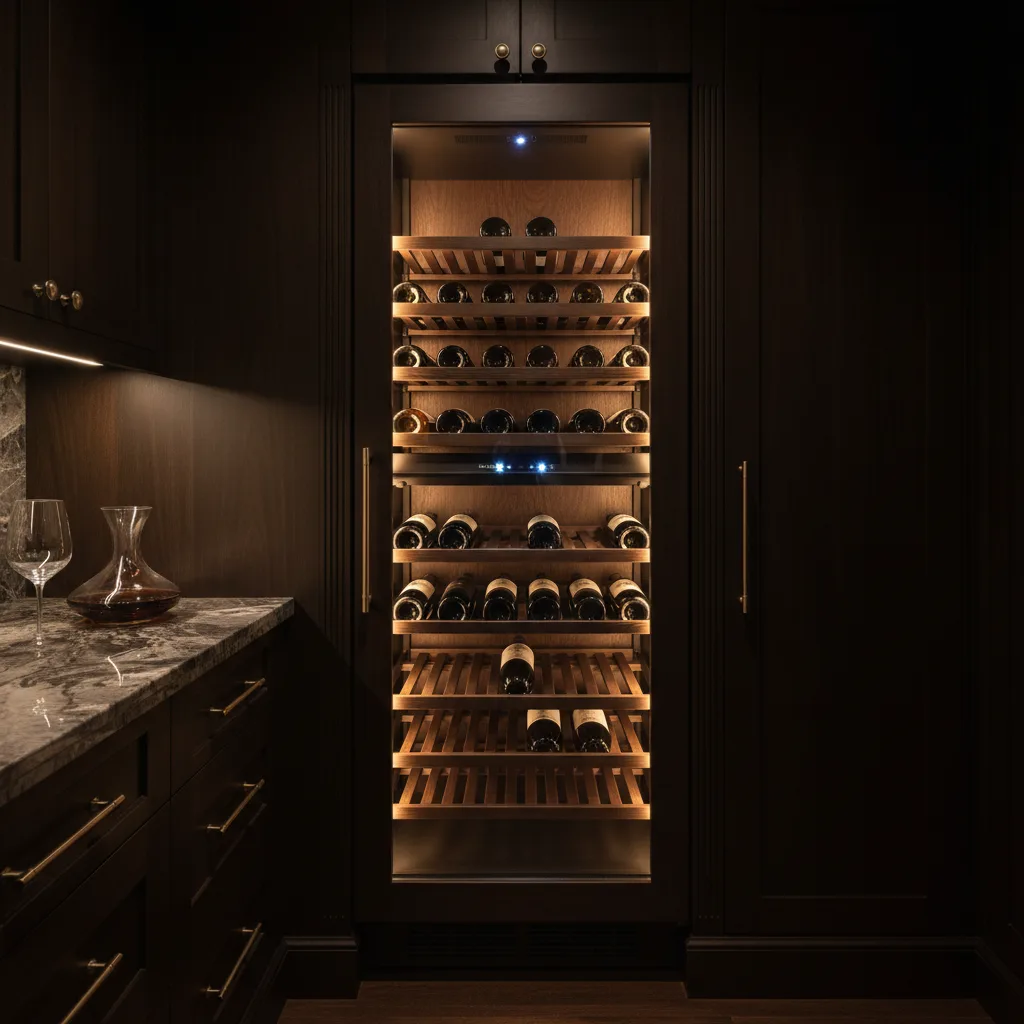
When a Wine Collection Is on the Line
A wine cooler failure is rarely just an inconvenience. A red left unattended at 68°F for a week, or a case of Champagne that swings through temperature cycles, can quietly ruin bottles that took years to build a collection around.
We get calls from homeowners in Heritage Hills and Carriage Club whose 150-bottle built-in units have stopped cooling the lower zone, and from condo owners in the DTC area with countertop coolers that run constantly but never reach set temperature. Both problems trace back to a handful of failure points: a failing compressor or thermoelectric module, a blocked or iced-over evaporator, a bad control board, or a door seal that's let humidity and cold air leak out for months without anyone noticing.
What makes wine cooler diagnosis different from a standard refrigerator call is the tolerance for error. A kitchen fridge running 3 degrees warm than ideal is a non-issue. A wine cooler running 3 degrees warm, or with humidity that's dropped from 60% to 35%, can start drying out corks and letting oxygen creep into a bottle. We test both temperature zones independently, check humidity sensor readings against an external hygrometer, and inspect the compressor or Peltier module before touching anything else, so we don't guess at what's actually wrong.
Founded in 2014, Lone Tree Appliance Repair has serviced wine refrigeration equipment from Sub-Zero, Wolf, U-Line, and other premium and mid-range brands throughout Lone Tree, Castle Rock, Highlands Ranch, Centennial, Greenwood Village, and Littleton. We are an independent repair company, not affiliated with or certified by any manufacturer, and we use OEM-quality parts specified for the unit we're working on.
How We Diagnose a Wine Cooler
Wine cooler problems tend to hide in the details, so our process is built to catch what a quick look would miss.
- 01
Zone-by-zone temperature check
We log actual temperatures in each zone against the display setpoint over time, not just a single reading, because compressor short-cycling and thermoelectric drift both show up as a pattern, not a snapshot.
- 02
Compressor or thermoelectric test
For compressor-based units, we check refrigerant-side performance, condenser fan draw, and start-relay behavior. For thermoelectric (Peltier) units, we test the module's DC voltage draw and the heat sink fan, since a weak fan is the most common cause of a thermoelectric unit that runs warm.
- 03
Humidity and airflow inspection
We check for iced evaporator coils, blocked air channels between zones, and door gasket seal integrity, all of which affect the 50-70% relative humidity range most collections need to keep corks from drying out.
- 04
Noise and vibration isolation
If the complaint is noise rather than temperature, we isolate whether it's the compressor mount, a fan bearing, or bottle rack vibration, since a cooler installed near a living space or open-concept kitchen needs to run near-silent.
Thermoelectric vs. Compressor Wine Coolers: What Fails Differently
The cooling technology inside your unit changes both what breaks and how we fix it.
| Issue | Thermoelectric (Peltier) units | Compressor units |
|---|---|---|
| Typical failure | Peltier module wears out or heat sink fan fails, causing slow warming | Compressor relay, start capacitor, or the compressor itself fails, often with a loud hum or no cooling at all |
| Temperature range affected | Struggles most in warm rooms or garages; usually can't hold more than 20°F below ambient | Holds temperature regardless of room conditions, down to standard wine storage range |
| Repair approach | Replace module or fan, often less invasive and quicker | Evaluate refrigerant circuit, replace relay/capacitor or compressor, may need brief refrigerant recovery |
| Noise profile | Nearly silent when healthy, so any new noise usually means the fan bearing | Some compressor hum is normal; new rattling or grinding signals a mount or internal compressor issue |
| Best long-term fix | Module replacement restores full performance | Compressor-based repairs are usually the more durable long-term fix for larger collections |
Dual-Zone Units: Diagnosing Two Climates in One Cabinet
Dual-zone wine coolers are common in RidgeGate and Meridian homes, where a 55°F red zone sits above or beside a 45°F white/Champagne zone. When one zone fails but the other works fine, it points to a specific component rather than a general system failure.
If the upper zone runs warm while the lower zone is fine, the problem is usually a zone-specific damper, sensor, or a partially blocked airflow duct between compartments rather than the compressor itself, since the compressor serves both zones through shared refrigeration lines. We isolate this with independent sensor testing at each zone rather than replacing parts on a guess.
If both zones drift simultaneously, the shared component (compressor, main control board, or condenser fan) is the more likely culprit. We explain which scenario applies to your unit before recommending a repair path, and we always confirm with a $89 diagnostic visit that's credited toward the repair if you move forward, so you're not paying twice to find out what's wrong.
A wine cooler that's slowly drifting warm is often more urgent than one that's stopped completely, because the bottles inside are still being damaged while the display still reads normal.
— Our lead technician, on why early diagnosis matters for wine storage
Why is my wine cooler running but not cooling properly?
This usually points to a failing compressor relay, a worn thermoelectric module, a blocked condenser fan, or a refrigerant issue, depending on whether your unit is compressor-based or thermoelectric. Lone Tree Appliance Repair tests each system component and both temperature zones independently to identify the actual cause rather than guessing. Call (720) 575-1433 to schedule a diagnostic visit anywhere in the Lone Tree, Castle Rock, or Highlands Ranch area.
Can a wine cooler be repaired instead of replaced?
In most cases, yes. Component failures like a bad compressor relay, thermoelectric module, control board, or door seal are repairable and considerably less expensive than replacing a built-in unit, which can require cabinetry work. Lone Tree Appliance Repair repairs wine coolers from Sub-Zero, U-Line, Wolf, and other brands starting from $89 for diagnosis, with the fee credited toward the repair. Reach us at (720) 575-1433.
Who repairs wine coolers near Lone Tree, Colorado?
Lone Tree Appliance Repair is an independent appliance repair company serving Lone Tree, Castle Pines, Parker, Centennial, Highlands Ranch, Castle Rock, Greenwood Village, and Littleton since 2014. We are not affiliated with or authorized by any manufacturer, and we service wine coolers and wine refrigerators with OEM-quality parts. Book a visit at (720) 575-1433 or online, with service visits daily from 8 AM to 6 PM.
How much does wine cooler repair cost?
Repairs start from $139, with final pricing set after an on-site diagnosis since compressor replacement, thermoelectric module swaps, and control board repairs all carry different parts and labor costs. Every visit includes an $89 diagnostic fee that's credited toward the repair if you proceed.
Why does my wine cooler have low humidity even though it's cooling fine?
Low humidity usually points to a door seal that's lost its compression, a cracked or warped gasket, or airflow that's bypassing the humidity control system entirely. This is common even when the cooling system is working perfectly, since temperature and humidity are controlled by different components. We check gasket seal integrity as a standard part of every wine cooler diagnostic.
My wine cooler is making a loud humming or buzzing noise. Is that normal?
A soft, steady compressor hum is normal for compressor-based units. A loud buzz, grinding sound, or a noise that changes pitch usually signals a failing start relay, a loose compressor mount, or a fan bearing wearing out. Thermoelectric units should run nearly silent, so any new noise from one of those typically means the heat sink fan needs replacement.
Do you repair both built-in and freestanding wine coolers?
Yes, we service built-in, undercounter, and freestanding wine coolers and wine refrigerators, including single-zone and dual-zone models. Built-in units sometimes require additional care around ventilation clearances, since restricted airflow behind a cabinet-enclosed unit is a common cause of repeat compressor failures.
Can altitude affect how my wine cooler performs?
Wine coolers are electrically driven refrigeration or thermoelectric systems, so Lone Tree's roughly 5,980-foot elevation has far less impact on them than it does on gas appliances. That said, thinner air can slightly reduce heat sink and condenser fan cooling efficiency in warm rooms, which is one more reason ventilation clearance around the unit matters.
Rated 4.9 by Lone Tree-area homeowners
Sub-Zero column refrigerator stopped cooling after a power fluctuation. Tech arrived next morning, diagnosed a control board fault, sourced the part, and had everything running within four days. The $89 diagnostic was credited toward the repair — exactly as promised. Truly professional.
Wolf dual-fuel range burners were flaring unevenly at different heights. Diagnosed as an altitude calibration issue: gas pressure wasn't adjusted for nearly 6,000 feet. Fixed on the spot. This is the specialist knowledge you simply cannot get from a generic repair company.
Miele dishwasher failed to drain mid-cycle. Called at 7 PM, a real person answered. Next-morning visit, drain pump replaced, done in under two hours. Clean work, honest quote before they touched anything. Will use again without question.
Viking refrigerator repair required a part order and a return visit, but communication was consistent throughout and the final price was exactly as quoted. The refrigerator has run without issue ever since. Good experience overall.
Thermador range spark igniter failed on all four burners. Single-visit diagnosis and repair — the technician had the correct igniter assembly in his truck. Diagnostic fee credited to the repair, no surprises on the bill. Clearly knows Thermador.
Sub-Zero wine cooler was drifting off temperature. Technician found a defrost heater fault and thermocouple calibration drift — both repaired in the same visit. Very impressed with the depth of knowledge about high-end Sub-Zero refrigeration.
Wolf wall oven convection fan seized right before the holidays. They worked us in on short notice, replaced the fan motor, and had the oven back in service for Christmas dinner. Above and beyond.
Gaggenau oven throwing error codes. Correct diagnosis on first visit — temperature probe failure — part in stock, repaired same day. The technician's familiarity with Gaggenau specifically was evident. Exactly the service these appliances deserve.
Ready to get your appliance fixed?
Call us any time — the line is answered 24/7 — or book a visit online in under a minute. Service visits run daily, 8 AM–6 PM.